




Aliphatic heterocycles are a class of organic compounds that contain one or more heteroatoms (such as nitrogen, oxygen, or sulfur) within a non - aromatic ring structure. These compounds play a crucial role in various fields, including pharmaceuticals, agrochemicals, and materials science. One of the key aspects that influence the properties and reactivity of aliphatic heterocycles is their hydrogen - bonding interactions.
Understanding Hydrogen Bonding
Hydrogen bonding is a special type of intermolecular force that occurs when a hydrogen atom is covalently bonded to a highly electronegative atom (such as nitrogen, oxygen, or fluorine) and is attracted to another electronegative atom in a neighboring molecule. In the context of aliphatic heterocycles, the heteroatoms within the ring can participate in hydrogen - bonding interactions, either as hydrogen bond donors or acceptors.
For example, in an aliphatic heterocycle containing a nitrogen atom, the lone pair of electrons on the nitrogen can act as a hydrogen bond acceptor. If there is a hydrogen atom attached to an electronegative atom in a neighboring molecule, a hydrogen bond can form between the nitrogen and the hydrogen. Similarly, if the aliphatic heterocycle has a hydrogen atom bonded to a heteroatom like nitrogen or oxygen, it can act as a hydrogen bond donor.
Hydrogen - Bonding in Different Aliphatic Heterocycles
Piperidine - Based Compounds
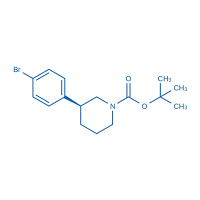
Piperidine is a six - membered aliphatic heterocycle with a nitrogen atom in the ring. Compounds like Tert - Butyl (3s) - 3 - (4 - bromophenyl) - piperidine - 1 - carboxylate can exhibit interesting hydrogen - bonding behaviors. The nitrogen atom in the piperidine ring can act as a hydrogen bond acceptor. If there are hydroxyl groups or other hydrogen - bond - donating groups in the vicinity, a hydrogen bond can form. This interaction can influence the solubility, melting point, and reactivity of the compound. For instance, in a polar solvent, the hydrogen - bonding between the piperidine nitrogen and the solvent molecules can enhance the solubility of the compound.
Oxetane - Based Compounds
Oxetane is a four - membered aliphatic heterocycle with an oxygen atom in the ring. (3 - Methyloxetan - 3 - yl)methanamine contains both an oxetane ring and an amine group. The oxygen atom in the oxetane ring can act as a hydrogen bond acceptor, while the hydrogen atoms on the amine group can act as hydrogen bond donors. This dual nature of hydrogen - bonding capabilities can lead to the formation of complex hydrogen - bonding networks in the solid state or in solution. These networks can affect the physical properties of the compound, such as its crystal structure and thermal stability.


Azetidine - Based Compounds
Azetidine is a four - membered aliphatic heterocycle with a nitrogen atom in the ring. 3 - (Methylsulfonyl)azetidine Hydrochloride, 3 - (Methylsulphonyl)azetidine HCl has a nitrogen atom in the azetidine ring that can participate in hydrogen - bonding. The chlorine atom in the hydrochloride salt can also influence the hydrogen - bonding environment. The presence of the methylsulfonyl group can further modulate the hydrogen - bonding interactions by affecting the electron density around the nitrogen atom.
Impact of Hydrogen - Bonding on Properties
Solubility
Hydrogen - bonding interactions can significantly affect the solubility of aliphatic heterocycles. Compounds that can form strong hydrogen bonds with the solvent molecules are more likely to be soluble in polar solvents. For example, if an aliphatic heterocycle has a hydrogen - bond - donating group and the solvent has a hydrogen - bond - accepting group, the compound will dissolve more readily. This is because the hydrogen - bonding between the compound and the solvent molecules stabilizes the solvated state.
Reactivity
Hydrogen - bonding can also influence the reactivity of aliphatic heterocycles. It can affect the electron density distribution within the molecule, which in turn can impact the reaction sites. For instance, if a hydrogen bond is formed near a reactive center, it can either enhance or inhibit the reaction depending on the nature of the interaction. A hydrogen bond that stabilizes a transition state can increase the reaction rate, while a hydrogen bond that restricts the movement of the reactive groups can decrease the reaction rate.
Biological Activity
In the field of pharmaceuticals, hydrogen - bonding interactions of aliphatic heterocycles are of great importance. Many drugs contain aliphatic heterocyclic moieties, and their hydrogen - bonding capabilities allow them to interact with biological targets such as enzymes and receptors. For example, a hydrogen bond between a drug molecule and a specific amino acid residue in a receptor can determine the binding affinity and selectivity of the drug.
Our Role as an Aliphatic Heterocycle Supplier
As a leading supplier of aliphatic heterocycles, we understand the significance of hydrogen - bonding interactions in these compounds. We offer a wide range of high - quality aliphatic heterocycles, including the ones mentioned above. Our products are carefully synthesized and characterized to ensure their purity and quality. We have a team of experienced chemists who can provide technical support and guidance on the properties and applications of our aliphatic heterocycles.
If you are interested in purchasing our aliphatic heterocycles or have any questions regarding their hydrogen - bonding interactions and applications, we invite you to contact us for a detailed discussion. Our experts are ready to assist you in finding the right compounds for your specific needs.
References
- Smith, J. A. "Hydrogen Bonding in Organic Compounds." Journal of Organic Chemistry, vol. 45, no. 12, 1980, pp. 2345 - 2352.
- Jones, B. C. "Aliphatic Heterocycles: Structure and Reactivity." Wiley - VCH, 2015.
- Brown, R. D. "Hydrogen Bonding in Drug - Receptor Interactions." Pharmacological Reviews, vol. 32, no. 3, 1980, pp. 213 - 234.